Spread the Movement The Danger of Mixing Purpose: Why One…
India is asking its citizens to support Indian-made products.
This is not a small appeal. It is a national call. Every time an Indian buys a product made in India, the benefit does not stop with one company. It travels through workers, factories, transporters, vendors, raw-material suppliers, service providers, tax systems, local economies, and families.
A purchase is not just a transaction.
At scale, it becomes economic participation.
But there is one missing link.
How does the ordinary Indian consumer identify a Made in India product instantly?
India is a country of 140 crore people, many languages, different levels of literacy, crowded markets, rushed shopping decisions, and thousands of products competing for attention. In such a country, information must not be hidden in fine print. It must not depend on the consumer’s patience, eyesight, education, language comfort, or digital access.
It must be simple.
It must be visual.
It must be immediate.
That is the purpose of One Nation One Symbol for Made in India.
It is not another slogan. It is not another publicity campaign. It is a call for one official, universal, national visual symbol that tells every consumer one clear thing:
This product was made in India.
Nothing more.
And that clarity is crucial.
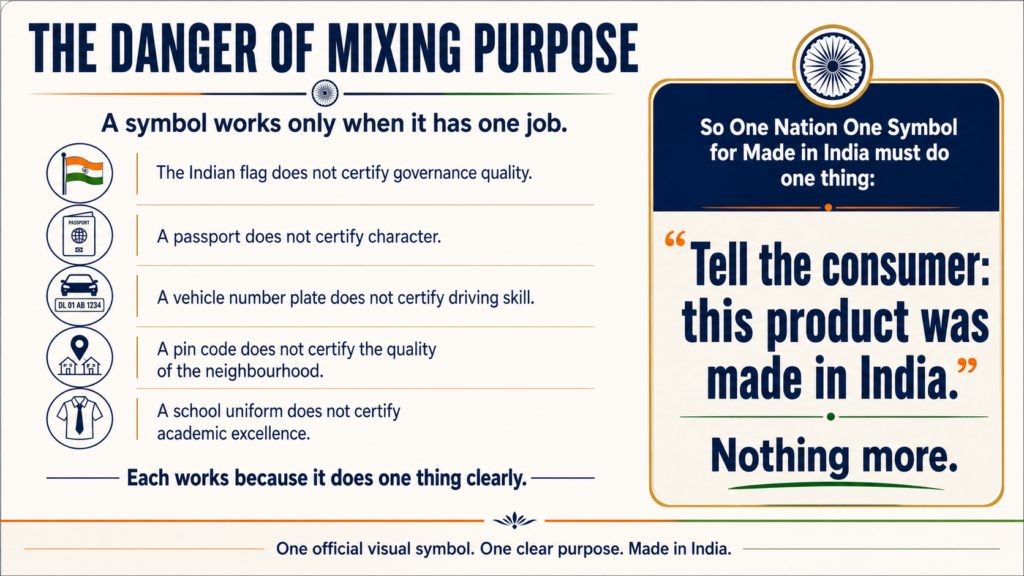
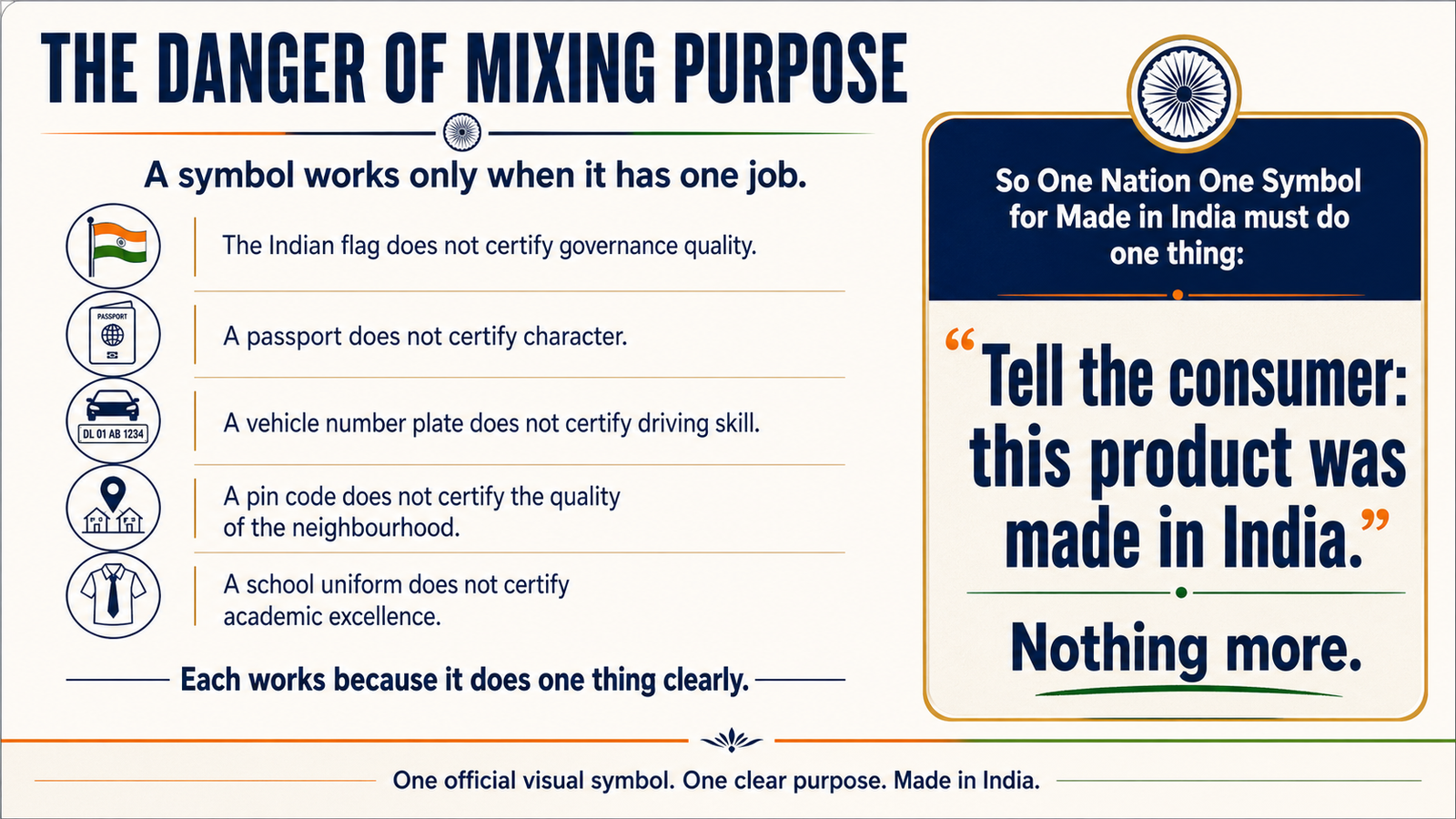
A symbol works only when it has one job.
The Indian flag does not certify governance quality.
A passport does not certify character.
A vehicle number plate does not certify driving skill.
A pin code does not certify the quality of the neighbourhood.
A school uniform does not certify academic excellence.
Each of these symbols works because it does one thing clearly.
The Indian flag identifies the nation. A passport identifies nationality. A vehicle number plate identifies registration. A pin code identifies a postal area. A school uniform identifies association with a school.
Their power lies in their simplicity.
If we overloaded any of these symbols with multiple meanings, they would lose their usefulness.
Imagine if a passport also tried to certify a person’s honesty, professional competence, financial status, and moral character. It would become impossible to issue, difficult to trust, and useless for its primary purpose.
This is the danger of mixing purpose.
The same danger applies to One Nation One Symbol for Made in India.
A symbol for Made in India must not become a certificate of quality, sustainability, price, ethics, safety, luxury, or excellence. These are important matters, but they are separate matters. They require separate standards, separate certifications, separate systems of inspection, and separate accountability.
One Nation One Symbol for Made in India has a different job.
Its job is not to say, “This is the best product.”
Its job is not to say, “This is the cheapest product.”
Its job is not to say, “This is a premium product.”
Its job is not to say, “This company has passed every possible test of excellence.”
Its job is only to say:
This product was made in India.
That may sound simple. But it is not small.
It is nation-building infrastructure.
Because before a consumer can choose Indian, the consumer must be able to identify Indian.
Today, the intention already exists in millions of hearts. Many Indians want to support Indian manufacturers. Many want their purchases to contribute to Indian jobs, Indian enterprise, Indian taxes, Indian innovation, and Indian confidence.
But intention alone is not enough.
Intention needs an instrument.
One Nation One Symbol for Made in India can become that instrument.
A simple national symbol on packaging, shelves, e-commerce listings, advertisements, invoices, catalogues, and retail displays can help consumers make quicker and more informed choices.
It can help senior citizens who may struggle to read small print.
It can help consumers who are not comfortable reading English.
It can help people shopping in a hurry.
It can help those buying in crowded markets.
It can help children begin to recognise Indian-made products from a young age.
It can help the consumer who wants to support India but does not have the time or ability to decode every label.
Most importantly, it can help small and medium Indian manufacturers.
Large brands have marketing budgets. They can hire agencies, buy advertising, dominate shelves, build recall, and influence perception. Smaller manufacturers often cannot. Many make good products, employ local people, pay taxes, and contribute to the Indian economy, but remain invisible in the mind of the consumer.
A national Made in India symbol can give them a common language of identity.
It can help them stand on the shelf with dignity.
It can tell the consumer, instantly and officially, that this product belongs to India’s manufacturing story.
That is why the purpose must not be diluted.
The moment One Nation One Symbol for Made in India is mixed with quality ratings, complex certification layers, or bureaucratic gradations, it risks becoming niche. It will no longer be a universal consumer symbol. It will become a technical label understood by a few and ignored by many.
India does not need a complicated mark that only experts can decode.
India needs a symbol that a child, a senior citizen, a busy mother, a shopkeeper, a factory worker, a student, a farmer, and a professional can all understand in one glance.
One nation.
One symbol.
One simple meaning.
Made in India.
This does not mean quality is unimportant.
Quality matters deeply. Indian products must become better, stronger, more reliable, more innovative, and more globally competitive. India must aim not only to make more, but to make better. But quality improvement is a parallel national mission. It should not be confused with the basic right of the consumer to know where a product was made.
Country of origin is identity.
Quality is performance.
A passport tells nationality. It does not tell the character.
In the same way, One Nation One Symbol for Made in India should tell the origin. It should not attempt to certify everything else.
This distinction is not academic. It is strategic.
If the symbol is kept simple, it can scale across categories, sectors, languages, regions, and platforms. It can become part of everyday consumer behaviour. It can travel from the kirana shop to the supermarket, from the e-commerce screen to the export shelf, from school projects to national campaigns.
But if it is burdened with too many functions, it will slow down before it even begins.
The strength of One Nation One Symbol for Made in India lies in purity of purpose.
A filter works on a screen.
A symbol works everywhere.
It walks with the product.
It sits on the packet.
It stands on the shelf.
It enters the home.
It stays in public memory.
For a country as vast and diverse as India, that matters.
A symbol can compress a national idea into one instant of recognition. It can turn a scattered intention into a visible habit. It can make support for Indian manufacturing easier, faster, and more democratic.
That is the power One Nation One Symbol for Made in India seeks to unlock.
Not as decoration.
Not as a slogan.
Not as a certificate of perfection.
But as a clear, official, trusted visual identity for products made in India.
Because when a symbol has one job, people understand it.
And when 140 crore people can understand something in one glance, it has the power to become a movement.
One Nation One Symbol for Made in India must do one thing.
Tell the consumer: this product was made in India.
Nothing more. Nothing less.
Spread the Movement The Danger of Mixing Purpose: Why One…
Spread the Movement Prosperity Brings Peace: One Nation One Symbol…
Spread the Movement India Can’t Afford to Wait for Perfect…
Spread the Movement One Symbol. Crores of Jobs. A Stronger…
Spread the Movement One Nation One Symbol: A People’s Movement…
Spread the Movement The Right to Know: Why Country of…